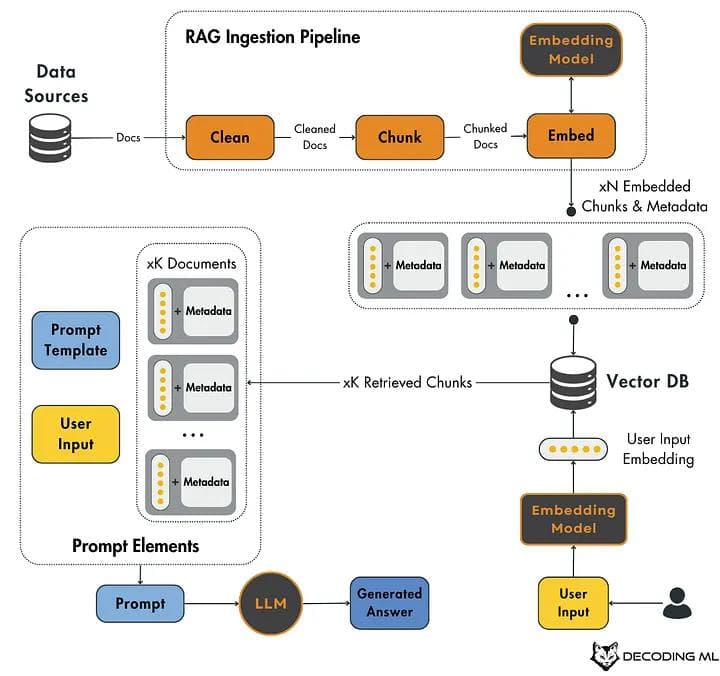
Hello guys, as I have told you before I have been learning AI and LLM Engineering from few months now and I am mainly working on Retrieval-Augmented Generation (RAG) pipelines and AI agents in production.
As I think this is the one area which is not very hard to master and also going to generate massive value.
It’s no surprise that 90% of my work comes down to a handful of core ideas — ideas I didn’t get from endless scrolling or free YouTube rabbit holes, but from reading books written by experts.
I have been following the classic and my tried and tested way of learning by building stuff and then learning when I get stuck, this research mode works best for me because when I get stuck then I crave for learning and that time I learn best.
But for learning, you also need to have right resources.
In the past, I have shared best AI books, courses and AI Engineering roadmap, and in this post, I’m sharing few books to master RAG and building real AI agents. This is not a huge list but a collection of tried and tested books.
They have been written by experts and they’ve all been tested in real projects — LLM-powered apps, vector databases, multi-agent setups — and they still deliver.
And, if you ask me how to learn AI and LLM Engineering, I would say, don’t wait until you’ve “finished” learning to start building.
Start building now. Learn alongside your projects.
9 Best Books to Learn Retrieval-Augmented Generation (RAG) pipelines and AI agents
Without any further ado, here are the 7 books you can read to master RAG pipelines and how to build and ship AI Agents in 2025.
1. Fundamentals of Data Engineering: Plan and Build Robust Data Systems — Joe Reis & Matt Housley
Fundamentals of Data Engineering by Joe Reis and Matt Housley provides a comprehensive framework for understanding modern data pipelines, architectures, and workflows.
It takes you through the data lifecycle, from ingestion and storage to transformation, orchestration, and serving, while emphasizing scalability, reliability, and business alignment.
The book blends theory with practical insights, making it ideal for engineers, analysts, and architects who want to design robust data systems. This book will harden your data layer so everything else stands strong.
I highly recommend this book because no foundation = no reliable models.
Here is the link to get this book — Fundamentals of Data Engineering
2. Practical Statistics for Data Scientists — Peter Bruce & Andrew Bruce
Practical Statistics for Data Scientists by Peter Bruce and Andrew Bruce distills statistical concepts into clear, actionable guidance for data analysis and machine learning.
This book covers topics like probability, regression, resampling, and Bayesian methods, it bridges the gap between academic theory and practical application.
Why it’s gold:
- Explains stats in plain English, no over-complication.
- Bridges the gap between theory & implementation.
- Still relevant whether you’re cleaning data, building features, or evaluating models.
The examples and R/Python code snippets make it an essential reference for data scientists who need to apply statistical thinking in everyday work.
Here is the link to get this book — Practical Statistics for Data Scientists
3. NLP with Transformers — Lewis Tunstall, Leandro von Werra, Thomas Wolf
NLP with Transformers by Lewis Tunstall, Leandro von Werra, and Thomas Wolf focuses on modern natural language processing techniques using transformer-based architectures.
It explains how to fine-tune and deploy models for tasks like text classification, summarization, and translation, using tools from Hugging Face’s ecosystem.
Why it matters:
- Gives you the pre-LLM foundation — tokenization, embeddings, sequence modeling.
- Helps you appreciate how transformers evolved.
- Very hands-on, lots of real code examples.
The book nicely combines theory, code, and real-world applications, making it a go-to resource for NLP practitioners working with state-of-the-art models.
Here is the link to get this book — NLP with Transformers
4. Designing Machine Learning Systems — Chip Huyen
Designing Machine Learning Systems by Chip Huyen is a comprehensive guide to taking ML projects from research to production.
It covers data pipelines, model development, testing, deployment, and monitoring, with a strong emphasis on iteration and feedback loops.
Drawing on author’s industry experience, it offers patterns, pitfalls, and best practices for building systems that are maintainable, scalable, and aligned with product goals.
Why I recommend it:
- Covers entire ML lifecycle: data pipelines, feature stores, deployment.
- Written from a production-first mindset.
- Saves you from rookie mistakes in scaling and maintenance.
To be honest this is most underrated book but a real gold. I highly recommend to anyone who wans to do well on AI Engineering field.
Here is the link to get this book — Designing Machine Learning Systems
5. Machine Learning System Design Interview — Ali Aminian & Alex Xu
Machine Learning System Design Interview by Ali Aminian and Alex Xu is a targeted preparation resource for ML system design interviews.
It teaches you how to approach open-ended ML design problems, covering topics like feature engineering, model selection, scalability, and monitoring.
Through structured frameworks, case studies, and real interview scenarios, it equips readers with the skills to confidently tackle high-stakes ML architecture discussions.
Why it’s not just for interviews:
- Forces you to think about trade-offs in system design.
- Introduces patterns you’ll reuse in real ML architectures.
- Broadens your understanding of complexity in large-scale systems.
Here is the link to get this book — Machine Learning System Design Interview
6. Hands-On Large Language Models — Jay Alammar & Maarten Grootendorst
Hands-On Large Language Models by Jay Alammar and Maarten Grootendorst is an accessible yet thorough introduction to working with LLMs.
The book guides readers through model architectures, training approaches, fine-tuning, and real-world deployment strategies.
Why I keep revisiting it:
- Covers embeddings → RAG → fine-tuning in one flow.
- Visual explanations make complex topics stick.
- Perfect if you want practical + theory in balance.
Rich with visuals, diagrams, and intuitive explanations, it’s designed to demystify complex concepts while offering practical projects for mastering tools like Hugging Face Transformers and open-source model hosting platforms.
Here is the link to get this book — Hands-On Large Language Models
7. Generative AI with LangChain — Ben Auffarth & Leonid Kuligin
Generative AI with LangChain (2nd ed.) by Ben Auffarth and Leonid Kuligin dives deep into building advanced applications with LangChain, the popular framework for LLM-powered systems.
It explains how to connect LLMs with external tools, databases, and APIs, enabling features like retrieval-augmented generation, multi-agent workflows, and domain-specific assistants.
Why it’s rare:
- Combines LangChain, LangGraph, multi-agent setups, streaming, and RAG in one book.
- Saves months of trial-and-error.
- This is literally what I wish existed when I started.
The second edition is updated with the latest LangChain capabilities, it offers end-to-end project examples to help developers move from prototypes to production
Here is the link to get this book — Generative AI with LangChain
8. AI Engineering — Chip Huyen
AI Engineering by Chip Huyen serves as a contemporary roadmap for building large-scale AI systems with practical, production-ready guidance.
The book unpacks everything from model versioning and scalable infrastructure to orchestration of LLMs and Retrieval-Augmented Generation (RAG) pipelines, offering real-world patterns and architectures.
Drawing on industry experience, Huyen walks you through the complexities of deploying models reliably — from latency considerations to monitoring, retraining, and maintaining system integrity. engineering practice.
Why it’s timely:
- Extremely current — covers LLMs, RAG, infrastructure, and multi-modal.
- Comes from someone building at scale, not just theorizing.
- Helps you think about engineering AI, not just “using” it.
Whether you’re launching your first AI service or optimizing an existing deployment, this book helps transform research and experimentation into robust
Here is the link to get this book — AI Engineering — Chip Huyen
9. The LLM Engineering Handbook by Paul Iusztin and Maxime Labonne
The LLM Engineering Handbook by Paul Iusztin and Maxime Labonne is a practical guide for building, deploying, and scaling large language model–based applications.
It covers everything from prompt engineering and fine-tuning techniques to evaluation frameworks and production best practices.
The authors focus on bridging the gap between research and real-world engineering, providing actionable advice, code examples, and architecture patterns for integrating LLMs into software products effectively.
I highly recommend this book to anyone who wants to learn how LLM works and how to tune them for their own need.
Here is the link to get this book — The LLM Engineering Handbook
How I use these Books in practice?
I keep these books as a “reference shelf” next to my desk.
When building an agent, I might have Hands-On LLMs open for prompt embeddings, Generative AI with LangChain for agent orchestration, and AI Engineering for deployment patterns — all at the same time.
If you work in production AI, especially with LLMs, these resources will compound your skillset faster than anything else I’ve found.
Other AI and Cloud Computing Resources you may like
- Top 5 Courses to Prepare for AIF-C01 Exam in 2025
- From Zero to AI Engineer: A 5-Step Roadmap to Build and Ship Real AI Systems in 2025
- How to Prepare for AWS Solution Architect Exam in 2025
- 5 Best Courses and Projects to Learn AI and ML in 2025
- 5 Projects You can Build to become an AI Engineer
- 6 Courses to learn Model Context Protocol in 2025
- 6 Udemy Courses to learn Agentic AI in 2025
- 6 Udemy Courses to learn AWS Bedrock in 2025
- Top 5 Udemy Courses for AWS Cloud Practitioner Exam in 2025
- 5 Best Courses to learn AWS SageMaker in 2025
- Top 10 Udemy Courses to learn Artificial Intelligence in depth
- Top 5 Udemy courses to build AI Agents in 2025
- 7 Best Courses to learn AWS S3 and DynamoDB in 2025
- 10 Best Udemy Courses to learn Artificial Intelligence in 2025
- 8 Udemy courses to learn Prompt Engineering and ChatGPT
- 5 Best Udemy Courses to learn Building AI Agents in 2025
- Top 5 Udemy Courses to learn Large Language Model in 2025
Thanks for reading this article so far. If you find these Udemy Courses for learning Spring AI from scratch, including tools and libraries then please share with your friends and colleagues. If you have any questions or feedback, then please drop a note.
P. S. — If you are new to AI and LLM engineering and just want to do one thing then start with AI Engineering by Chip Huyen and The LLM Engineering Handbook by Paul Iusztin and Maxime Labonne, both of them are great books and my personal favorites. They are also highly recommend on Redditt and HN.